

The Sweet Future of a Billings Icon
New technology, same beloved cookie
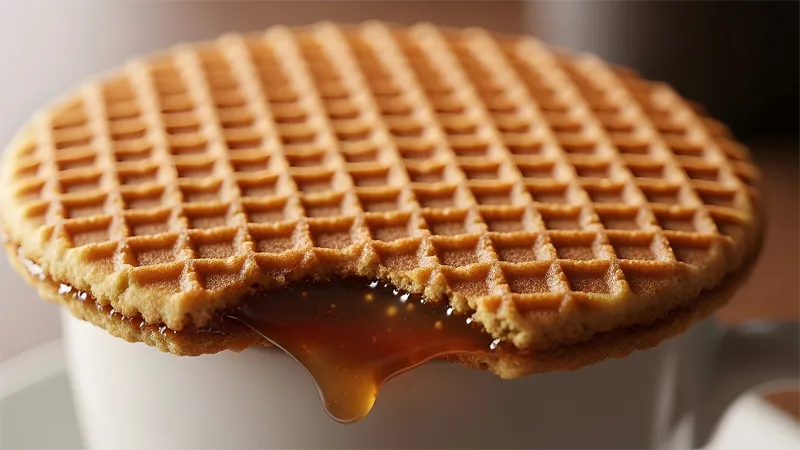
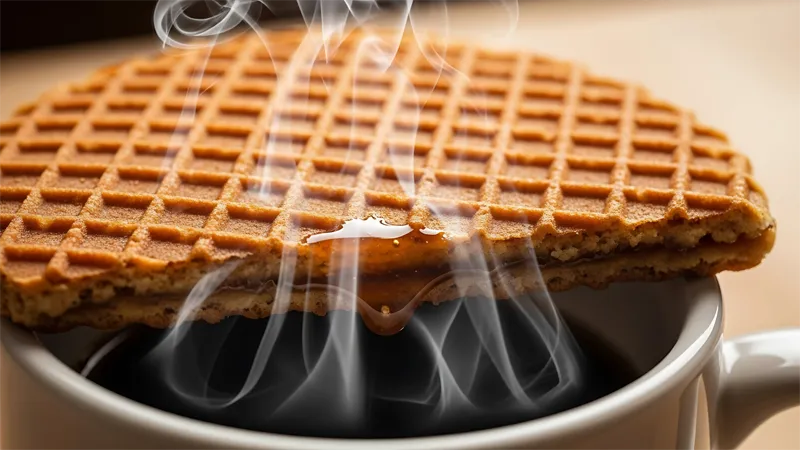
I am warming a Caramel Cookie Waffle on top of my steaming cup of coffee. Impatiently, I wait for the heat to soften the caramel center, making it soft and gooey. As I take my first bite of this Dutch-style stroopwafel, thin strands of caramel stretch from the middle layer, sandwiched between two thin vanilla-cinnamon-spiced waffle cookies.
As I think of my special ritual with Billings’ most iconic cookie, I am standing in front of the stroopwafel “speakeasy.” A “speakeasy” because this place deserves to have a coveted code word to enter the building with the nondescript dark-gray metal façade. There is no signage identifying what is inside, but I want to shout to the world that the Caramel Cookie Waffles that Jan and Judy Boogman first baked more than 40 years ago are being churned out here.
Three years ago, Lilly Corning-Thompson, Erin Heringer and Katie Edwards, purchased Caramel Cookie Waffles from the Boogmans, when the couple made the decision to retire. The white storefront with the large blue-lettered sign on 17th Street West remains mostly the same, except that Jimbo is gone. Jimbo was the beloved name given to the original stroopwafel oven from Gouda, Holland, with its eight rotating skillets.
Jan still recalls his tenure as owner. “The days were generally long, very long,” he says, “because I had to go in at 2:30 in the morning and get things going, and then the employees came in.” On those mornings, the hard-working employees and the heat of the oven literally left sweat on the storefront windows. The steaming of the glass indicated the oven was on, with a line of people spreading caramel on the freshly cooked wafers and sandwiching them together by hand.
The Boogmans had opportunities over the years to relocate to another location for increased production, but Jan says he preferred to keep his business more intimate. “We became the gathering place, a community gathering spot, and I felt very comfortable with that.”
Two years ago, the new owners moved the cookie-making operation to a dedicated production facility on top of the Rims. A temporary oven jury-rigged from a machine in storage provided interim production of cookies until mid-April of this year.
A new oven now lives in the 5,000 square foot space, Lilly says, speaking of the large custom-created machine delivered from the Netherlands. “It arrived in a big shipping container (and) Erin was here to help take it out.” Alongside Erin, her father, Al Blain, assisted in putting the system together.
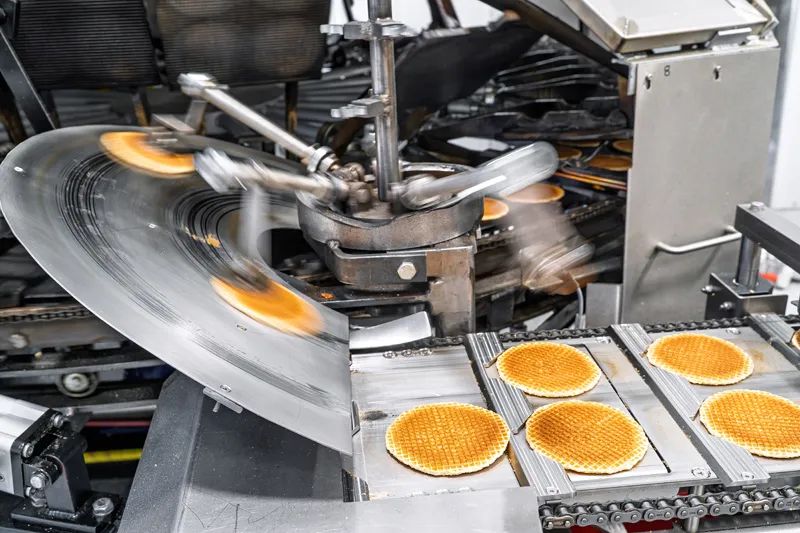
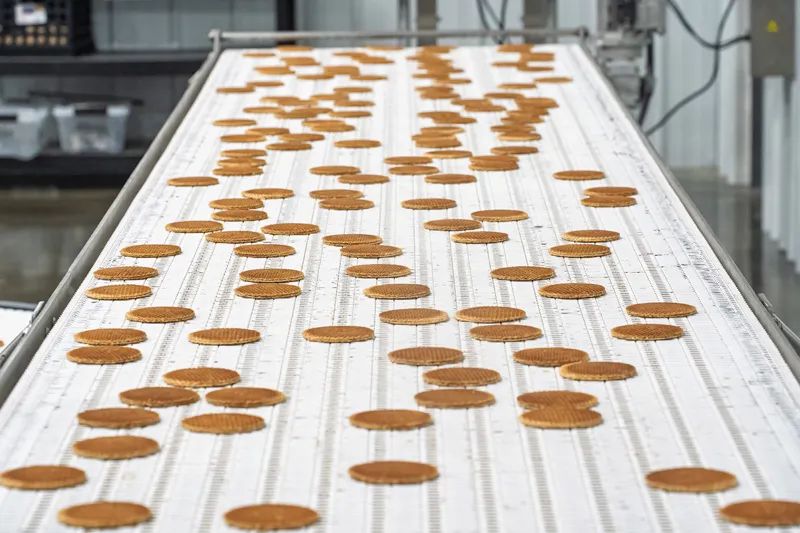
“This was my brainchild,” Lilly says of the contraption she helped design that’s situated in the main space, with a long conveyer belt that snakes into the next suite. She excitedly talks about a machine that now is more efficient in producing more consistent cookies at a faster rate, 17 minutes. She figured out the cooling curve for the cookies, from when they leave the cast iron skillet at 140 degrees to cooling to room temperature.
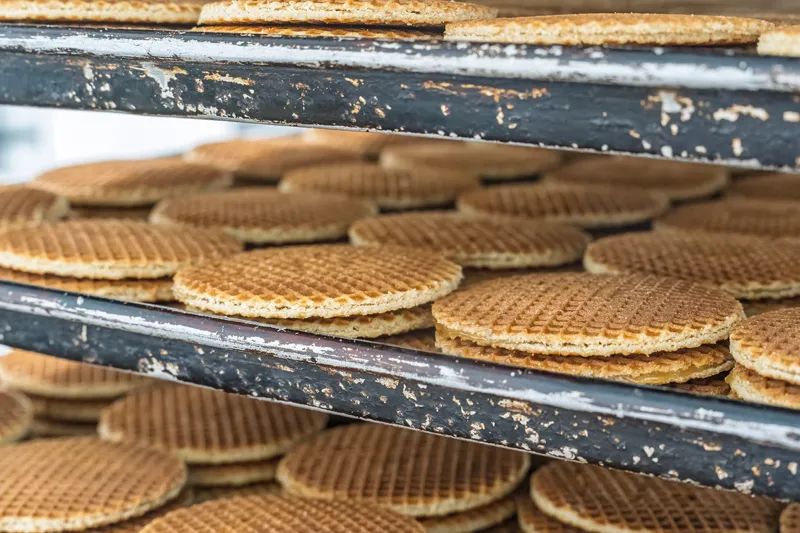
The dough is mixed in the mornings, at 5:00 a.m., in a tent where the enclosure keeps the flour dust from floating into the workroom. After the oven warms for 20 minutes, four round dough balls are extruded from the hopper onto one of the 22 iron skillets. The top plate of the skillet closes as it moves clockwise over flames and opens back up when cooking is complete, to then slide a hot cookie down a ramp. The cookies are trimmed into a circle and then split horizontally into two thin halves through a piano wire. After caramel is dispensed onto one of the wafer halves, the halves are pressed together. The cookies travel on a conveyor belt that moves from the main room through plastic sheeting strips into the next room that is set at a constant 60 degrees. After traveling about another 20 feet in the cooler space, the cookies arrive at the end, where workers are ready to receive them and put them into clear packaging for two cookies or a package of eight.
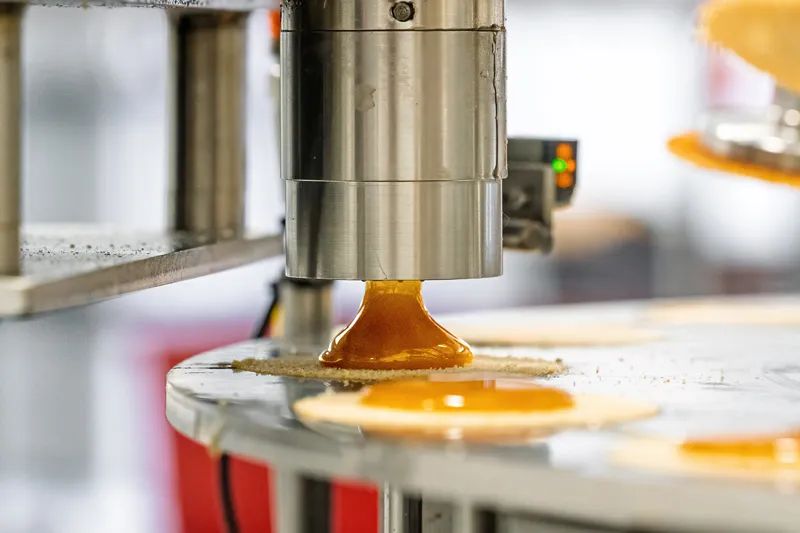
The three partners created a world-class facility that is easier on the employees.
“Sam used to get to the bakery at 4:00 a.m. Now she comes in at 7:30 a.m.,” Lilly says. Not to mention the increased cookie production. In the same time that it took to bake 1,200 cookies, the automated system now produces 4,000 of these caramel-laden creations.
Growing up with the cookies and visiting the bakery, the three partners have nostalgic memories of Caramel Cookie Waffles.
“I would go with Joanne Corning, my grandmother. She would take me there for lunch dates where I was treated like an adult,” Lilly says of her special times.
Katie admits with a laugh, “The caramel cookie was not my favorite and I ate a lot of them.” But the more she tasted them, she learned to like them and appreciate how they were made.
Erin shares how their business idea came together. “Lilly texted me about Christmas time, three years ago, and said, ‘Hey, you’re never going to believe what just came up for sale,” she says. “At first, we were joking about it, but then, when we actually looked at the numbers, we realized that it looked like this business had legs.” When the pair went to visit Katie, their banker, she immediately insisted on being a partner.
Adds Lilly: “We have a huge gratitude to Jan and Judy. They worked with us and thought we would fulfill their vision.” The trio even received expert advice from Robin Béquet, who started Béquet Confections in Bozeman, one of the nation’s premier caramel companies. Locals like Peter Yeagen provided electrical and mechanical expertise.
The new owners closed the bakery for two weeks last August. “All of us deep cleaned. We painted, organized the whole back,” Lilly says of cleansing and reorganizing over four decades of accumulated history. They put in a new freezer, moved out the original oven, took the art off the walls and moved the dessert case closer to the cash register.
The offerings remain the same, with almond crescents, curry chicken salad and sunflower bread still being made with Judy’s recipes. “There are affordable lunch options at Caramel Cookie Waffles,” Katie says especially when “this is a hard industry to make a profit.”
The trio got creative when it came to outfitting the production facility.
“We needed freezers and we had no money to buy brand new ones. Lovable Pets was going out of business, so I sat at the auction for the freezers that were last to be auctioned off,” Lilly says of the effort paying off as they got the equipment “pennies on the dollar.”
“We looked through the Billings classifieds. We became Facebook marketplace queens,” Katie says, describing their other efforts to save money. Then Erin had the connections to heavy equipment to get everything in place.
Most stroopwafel companies, “outsource their cookie making to Canada” Katie says. “We want jobs in Billings.”
“We so strongly believe in the product and the team,” Lilly adds.
Production manager Sam Biesheuvel believes the changes are good. “It’s more mechanical than before,” she says, no longer having to remove the cookies from the iron with a spatula or spread caramel onto the wafers. “Things go more smoothly so I enjoy doing it.”
Sam laments that Jan has not visited the new facility. “I basically took over his position,” he says. “I would love to see Jan, to show him what we’ve done. I want him to be proud of what we have done.”
What they have done is produce more cookies that can be distributed to more people who can practice my ritual of warming a Caramel Cookie Waffle atop a hot cup of coffee.