

Someone’s Daughter
Survivors and advocates work to expose the brutal reality of human trafficking
Editor’s Note: This story contains mature content. We have changed the names of the human trafficking survivors interviewed within this story to protect their identities. Their traffickers still move through and operate within Billings.
Through her volunteer work, Penny Ronning has become privy to some of the ugliest crimes known to man. It’s gritty work. She’ll tell you it’s often hard to carry, but her heart is tied around it for reasons that came long before she was born.
“I’m the daughter of a trafficking survivor,” Penny says.
From the time Penny’s mom was 5 years old until she was 9, she was sold for sex by her 16-year-old brother, Penny’s uncle.
“For four years, she and my aunt were raped every day and sold to neighboring farm boys to do with whatever they wanted,” Penny says. “She lived with that shame and that trauma.”
Penny admits, that because of the damage to her mother’s body, it was a miracle that she and her sister, Nita, were born.
When Penny came back to Billings in 2013 to take care of her mom after years of working and living elsewhere, “I wanted to give back to this community that raised me.” She wanted that work to honor her mom.
The Day Penny’s Eyes Opened
Penny became a Court Appointed Special Advocate (CASA), standing beside foster children as their cases went before the legal system. Her first case was a 15-year-old girl whose mother had died and whose father abandoned her at birth.
“Her mother willed her over to a meth dealer,” Penny says frankly. “At 15, she knew if she didn’t get out of that home, she probably wouldn't live much longer because it was so violent.” The girl ended up running, trying to survive on the street before eventually landing in the foster care system.
“She didn’t want to be there and so she ran away,” Penny says. By the time she was found, Penny adds, “She had been already drugged and raped. So now you have this trauma added on to all the other layers in her life."
Penny helped the teen heal and watched her succeed, despite her seven different placements over the next 11 months. By her senior year, the girl was getting straight As and landed her first job.
“She gets a job in a fast-food place where there was an employee there that saw every vulnerability in her and began to traffic her out of that restaurant for drugs,” Penny says. “That was the wake-up call for me.”
As Penny took a closer look at some of the files on the CASA caseload, she was shocked to learn how many of the children in their care had been trafficked. She made a call to the FBI. Not only did an agent and a victim’s witness specialist lead a training with CASA workers to identify the warning signs, it sparked a relationship that would plant the seeds for what would soon become the Yellowstone Human Trafficking Task Force (YHTTF).
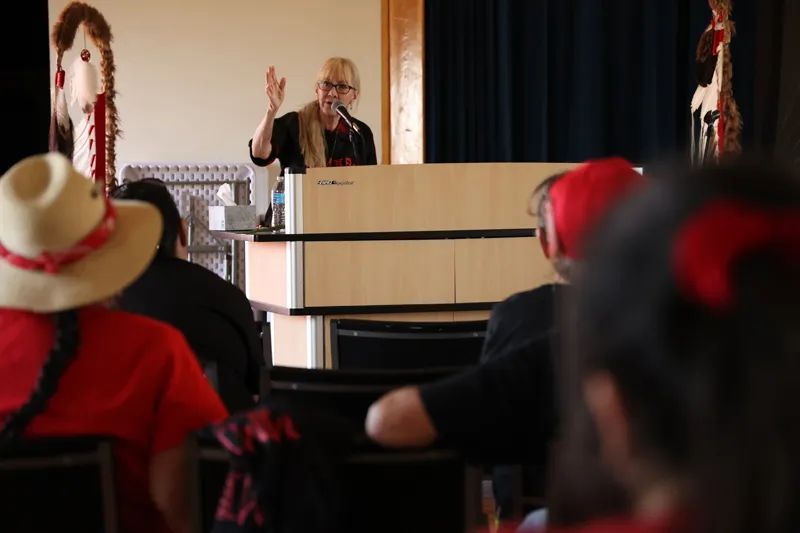
Within months, Penny helped launch the task force. Today, it has more than 1,000 members made up of those within government, law enforcement, medical, education, nonprofit agencies, victim’s services, business, state and federal justice systems, along with human trafficking survivors. It has championed changes to state and federal laws, making it harder for traffickers to operate within Montana, and has trained more than 65,000 people to identify warning signs.
Ten years later, Penny is still one of the task force’s leading voices.
“When we started this task force 10 years ago, there were no victims or survivors who were willing to tell their stories. Zero, zip, none,” Penny says. “No one was talking about trafficking. Law enforcement still saw it as prostitution.”
So, Penny started talking and she invited trafficking survivors from other states to help put a face on the crime. Slowly but surely, she gained the trust of survivors here and, over the years, she’s helped many of them find their voices.
“They speak out. And they lay that groundwork, they sow those seeds,” Penny says, sharing that a handful of them are now standing beside her, leading anti-human trafficking trainings statewide. “They don't always get to see the physical impact because it happens in so many different ways, but you look at where we are today versus where we were 10 years ago? That’s because of the courage survivors had to tell their story.”
Owned by an Organized Crime Family
Lynne was just 19 when she met a handsome man whose charm and affection, at first, concealed his dark side.
“We started talking every day, and he slowly pulled me away from my family and friends. He fed my addiction by giving me drugs. He gave me lavish gifts and outfits that I wouldn’t normally wear,” Lynne says, adding that the clothing was provocative. The drugs only heightened her addiction, which she now knows was intentional.
“He was desensitizing me to that lifestyle,” she says.
The man was the textbook case of what’s called “Romeo grooming.” This type of trafficker begins slowly with gifts and affection, building trust with each move.
“I just wanted to be loved,” Lynne says.
Over the next two years, his subversive control deepened. By the time Lynne boarded a plane to Las Vegas at 21, she believed she was making her own choices. Today, there is no doubt in her mind she was being manipulated.
“These predators work for months getting you to earn their trust until, before you know it, you’re in a situation that is super dangerous and almost always impossible to get out of,” Lynne says. “I became the property of an organized crime family.”
For the next four-and-a-half years, Lynne was exploited by a network that moved her through 27 strip clubs in Nevada, New Mexico, Indiana and Ohio. She was forced to meet a daily quota of $1,500. If she didn’t, she stayed in the club until she did, at times days on end without sleep or food. She was forced to sell drugs to make up any difference.
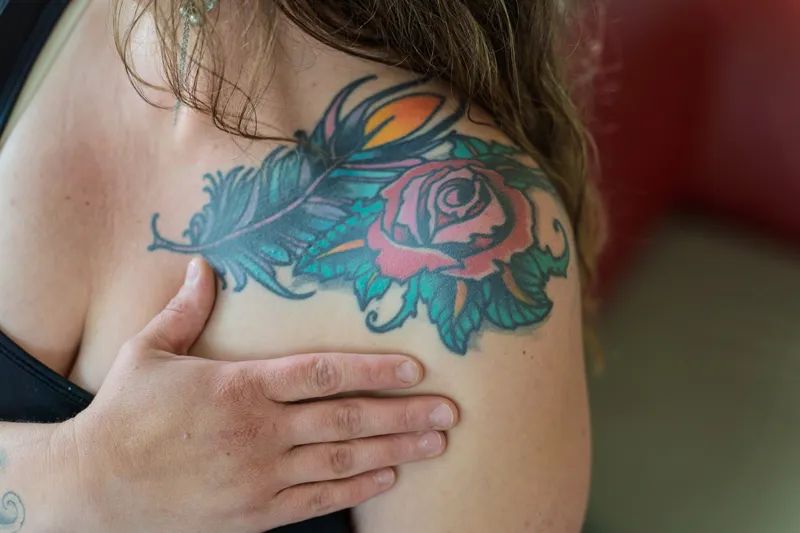
And then there was the late-night meet-up with a tattoo artist hired to mark Lynne and two other girls as gang property. The ink of the gang’s initials landed on the skin right under her collar bone.
“I remember crying and begging and pleading. I didn’t want a gang tattoo,” Lynne says. “I didn’t understand it was a branding at the time,” she says. The second part of her initiation? She and another woman were forced at gunpoint to sleep with the gang’s leader.
“Instead of the whole gang raping me, I had to sleep with the guy in charge. He was well into his 70s,” Lynne says, shaking her head. She remembers crying afterward, her trafficker promising the man would never touch her again. Lynne knows now that it was a classic example of what a trauma bond looks like — a cyclical pattern of abuse and manipulation followed by brief periods of intense affection. Lynne says it’s a mental game that made it difficult to leave.
Over time, Lynne was passed between several traffickers. Each time, the physical abuse and mind control deepened. She begged them to let her go.
“They told me that I could but if I did, they were going to replace me. They slid two pictures across the table. They were pictures of my younger sisters who lived in Billings, going into their schools. They were in elementary and junior high at the time,” Lynne says. “I would rather it be me than one of them.”
The violence got so bad, Lynne didn’t think she’d live to see 26.
“I took a chance,” Lynne says. She called her mom. “What’s the difference if I die trying to leave or because my trafficker finally strangles me to death? That was his go-to form of abuse.”
She told her mother the whole, ugly truth.
“I explained to her that it wasn’t just one person. It was an organization. I was really scared,” she says. She begged her mom not to call the police.
So her mom did something uncanny. She romanced the romancer.
“My mom befriended him,” Lynne says. “She was able to see past her rage and her fear and stay calm enough to play the part. It was absolutely amazing to me. Every narcissist loves having their ego stroked.”
It took a little more than six months to build the relationship. Then, Lynne’s mom put the escape plan in motion. She pretended Lynne’s grandfather was sick and said Lynne needed to fly home for a few weeks.
Her trafficker let her get on the plane.
Lynne describes the day as if it were yesterday. She kissed him goodbye and started to move through airport security. Every time she looked back to see if he was still watching, she’d blow him a kiss and wave. The second she moved around the corner out of sight, “I just dropped to my knees and started bawling because I felt like I could breathe for the first time in four-and-a-half years,” she says.
Lynne returned home at 25, still battling addiction and trauma. Today, at 36, she is a mother of five and continues to navigate nightmares, hypervigilance, and the lingering effects of years spent in survival mode.
“My head is always on a swivel,” she says. “My nervous system has never really come out of fight-or-flight.” Her groomer still lives in Billings and has ties to this multi-state ring.
That fact hasn’t stopped Lynne from becoming a survivor leader with the Yellowstone Human Trafficking Task Force. For the past few years, she’s joined Penny to help facilitate anti-human trafficking trainings with everyone from first responders and those in the medical field to hoteliers and service providers. Earlier this year, she became the first survivor to lead a statewide call in Montana, helping unite agencies, law enforcement and organizations working to combat exploitation.
Last year, brought one of her proudest moments — the day she spoke before the Montana Criminal Justice Oversight Council. Not only did she share her story in detail, “I got to give my opinion on all the different laws or statutes that need to be in place to make Montana safer.”
Her top priority is a requirement that all law enforcement undergo trauma-informed training so they can better identify what trafficking truly looks like.
She remembers telling the council, “No officer ever made me feel comfortable enough to disclose what was really happening in my life. I was treated as a criminal, just another addict, another problem, when in reality, I was someone’s daughter being sold.”
She is very candid about the realities of human trafficking.
“Our stories aren’t rare,” she says. “They’re just stories that are rarely told.”
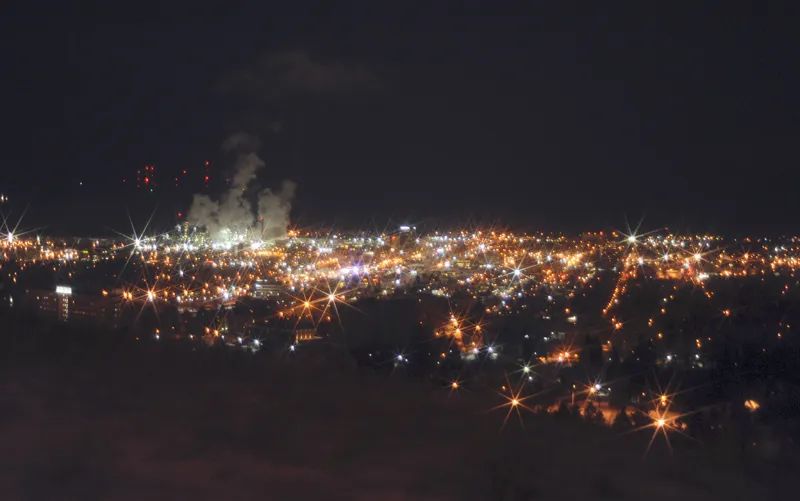
“Because Billings is centrally located, it is a convenient meeting spot. From here, the highways can take you east, west, north or south. ~Lynne, Human Trafficking Survivor
“Prison Saved My Life.”
Long before Elizabeth was trafficked across state lines, her story began as a little girl whose cries for help went unheard.
She was just 2 years old when her stepfather began sexually abusing her. At age 12, when she gathered the courage to speak out, instead of protection, she says, “Everything was kind of swept under the rug.”
Not long after, she was molested by a neighbor. This time, she stayed silent.
“I had already felt the shame of what speaking up does to you the first time,” she says. “I didn’t feel like my life was worthy.”
By her teens, Elizabeth turned to methamphetamine and eventually became deeply involved in the drug world, selling to support her addiction. Looking back, she says the childhood wounds left her vulnerable to the kind of person who knows exactly how to exploit brokenness.
“Predators can sense vulnerability like a dog can sense fear,” she says.
When she was 23, a man entered her life and said all the right things. He convinced her he loved her and that if she just did this one thing, namely sell her body for sex, they could build a future together. As time went on, Elizabeth became a young mother with a strong desire to leave that life behind. That’s when the threats against her and her daughter started.
“At that point, I was doing what I needed to do to keep my daughter safe,” she says.
The abuse escalated quickly. When she tried to leave, her trafficker took her to California. “That’s when I knew I was in danger,” she says. “He started pulling guns on me.”
For years, meth kept her awake through the darkest hours of the night, when traffickers said the most lucrative calls came in.
“I remember there were times I would be like, ‘why can't I find a prostitute serial killer?’ I was so low,” Elizabeth says, tears forming in her eyes.
When her beloved grandfather, the man she says never left her, became gravely ill, she fled and boarded a bus homeward bound. Federal marshals were waiting. She was arrested on outstanding drug warrants and sentenced to three years in prison.
What might seem like another tragedy, however, became the turning point.
“Prison saved my life,” she says.
Even though she feels prison was the catalyst to help her get clean, it’s also a classic case of what often happens to trafficking victims — forced criminalization that leads to prison time.
“The majority of women in prison in Montana, that’s the story,” Penny says.
A study by Polaris Project, an anti-trafficking nonprofit, revealed that 80% of trafficking survivors who had been arrested or detained were incarcerated for crimes they were forced to commit while they were actively being trafficked.
“Law enforcement failed them,” Elizabeth says.
Released in 2021, she is taking what she calls “baby steps” toward a future she once believed she would never have. At 37, she is working with Penny to become a survivor leader. It’s her mission to use her voice to strengthen protections for children. She believes when children are heard, believed and empowered after speaking out about sexual abuse, they are less vulnerable to trafficking and substance abuse later in life. She would also like to see harsher sentences for predators and more trauma-informed responses from the justice system. All of those things, she says, could prevent countless lives like hers from being derailed.
“I shouldn’t have seen the inside of prison walls before my abuser did,” she says.
Today, her daughter is 10. Elizabeth is fiercely protective of her.
“For the first time in my life, I feel like I actually have a future,” she says. “I feel like my voice is no longer going to be silenced. I know this is my life’s mission.”
Bringing Down a Multi-State Trafficking Ring
On any given week, Penny might field calls from a half-dozen people tied in some way shape, or form to human trafficking. On one week in 2019, Penny took a call from Denise Boggio, a member of YHTTF and an administrator with Yellowstone County Self-Help Law Center. She was helping a woman fill out the paperwork for a restraining order when red flag after red flag popped up. It all pointed to human trafficking.
“Denise called me and said, ‘I have this person sitting here.’ I said, ‘Convince her. Do everything you can to convince her to walk over to the FBI office,’” Penny says.
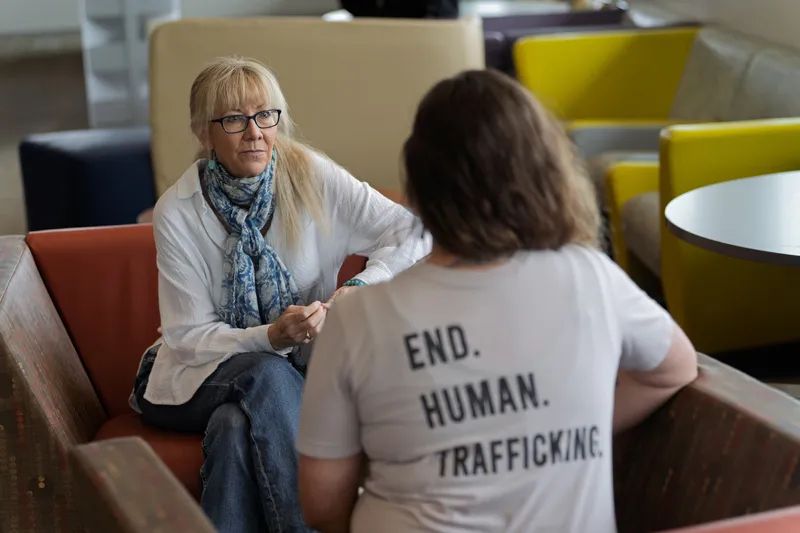
The woman, known only as Jane Doe, was one of the three women who sat down with YVW to talk about the realities of trafficking. She was the only one of the three who was trafficked out of a handful of Billings hotels. As she spoke about the drugs, coercion and intense violence, she wanted it to be made clear that human trafficking doesn’t always look like women chained up in basements.
The man who enticed her into the life called himself “December,” because, as he said, he was “cold, like a winter night.” His real name was Louis Venning.
He offered exactly what she desperately needed — drugs, shelter and promises of stability.
It took months, but when her trafficker began beating her to the point of blacking out, a family member rescued her. That's when she became one of the 13 Jane Does to testify in a federal case against Venning.
While Louis Venning pled guilty in November 2021 to sex trafficking by force, fraud and coercion, sex trafficking a minor, as well as cocaine possession with intent to distribute, authorities believe over the course of nearly 10 years, he exploited more than 80 women and minors as part of an interstate human trafficking ring. He’s now serving 30 years in prison followed by a lifetime of supervised release.
After sharing her story and all the intricacies of the Billings human trafficking scene, the woman decided a few weeks later she wasn’t ready for the intimate details of her case to be shared. We honored that request.
“Jane’s trafficker was brutal,” Penny says. “There are two of his victims that can’t sit and tell their story. So, Jane speaks for them.”
‘I still have work to do’
In time, Penny would love to turn the role of advocacy over to survivor leaders like Jane, Lynne and Elizabeth.
“Every single room they walk into, they walk in with this grace. They walk in and say, ‘I'm going to sit here and talk to you about the worst time of my life.’ They do it because on the other side of that, someone’s life is getting saved that they may never meet,” Penny says. “They give voice to the fact that, ‘This is what we look like and we are right here in front of you.’”
Penny says that in the beginning of her advocacy, people weren’t always willing to listen.
“It was a fight,” she says. It took years to bring her education to Billings Public Schools, to both hospitals, to hotels. “We had physicians tell us that this doesn’t happen. It’s not our problem. That is the language we would get coming back at us.”
In addition to education, Penny has been driven by concrete policy changes. “That's what keeps me going, and that's where my heart is,” she says.
Through her work, she’s helped get 15 state laws and five federal bills passed to strengthen laws targeting trafficking and exploitation. She’s also fought to expand investigative capacity, and was a strong voice to get the first two human trafficking detectives assigned to the Montana Department of Justice’s Criminal Investigation Bureau.
One of her toughest battles, however, was in 2018, when, as a Billings City Council member, she fought to regulate massage businesses. The goal was to have a tool to shut down illicit massage businesses where human trafficking took place.
“That was a brutal fight,” Penny says. “I got called every word in the book.” Legitimate massage therapists didn’t want added regulation.
Before Penny stepped onto the council, Billings had more illicit massage businesses per capita than New York City. There were just shy of 30 with each running three to five girls. After gathering firsthand knowledge from women forced to work in this setting, she learned one woman could earn upwards of $18,000 a month. It was an estimated $17 million-dollar annual industry in Billings. Just to give you perspective, last year, Billings took in $15.4 million in gambling revenue.
“The number is astounding,” Penny says.
In 2021, Mayor Bill Cole signed an ordinance that prohibited 24-hour massage parlors. The ordinance prohibited blacked-out or darkened windows. It required workers to maintain detailed logs of services and among other things, required fingerprinting to obtain a city license. The ordinance also permitted the city to conduct unannounced inspections of the premises during business hours. While the ordinance faced a legal challenge in late 2025, a federal appeals panel largely upheld the ordinance as constitutional limiting only inspections on home-based massage businesses.
By 2022, the ordinance led to the closure of every known illicit massage business operating in Billings. Today, it continues to serve as an effective mechanism for shutting down new establishments as they appear. It’s been so effective that other cities are taking notice. The city of Colorado Springs recently asked Penny to help them craft a similar ordinance.
But even with progress, Penny can’t forget the startling facts still alive within the world of trafficking today. After Back Page and City X Guide, two of the most profitable sites for escort ads, were shut down for aiding in human trafficking and money laundering, those websites moved overseas, out of the reach of federal law enforcement. You can still use them to find dozens upon dozens of ads promoting trafficking victims here in Billings. On top of that, the rise of technology more easily targets children with online video game chat rooms becoming prime spaces for predators. Once ensnared, a 14-year-old can sell for up to $900 an hour. The younger the age, the higher the price.
“Think about who can pay that price,” Penny says. “It’s not the homeless guy out there on the street. These are cash businesses.”
Sitting next to Jane, Penny looks at her and says, “I have love for this community, but at the same time, this is also the community that bought this beautiful human being. We have to reconcile that the reason trafficking happens here is because there are buyers here.”
As Jane gets up to leave, she gives Penny a tight embrace and whispers, “Thank you for everything you’ve done for me.”
It’s just the fuel Penny needs to go to battle another day.
“I can see the wins,” she says, nodding. “I can see the wins.”
Facts about Human Trafficking
- The Trafficking Victims Protection Act of 2000 is a landmark U.S. federal law that established the nation's framework for confronting human trafficking. It was the first piece of legislation to officially name the crime of human trafficking and brought federal efforts toward prevention and protection along with harsh penalties and asset forfeiture for convicted traffickers. One of the elements of the law allows victims to sue the motel industry or any business where there should have been reasonable knowledge that trafficking was taking place on site.
- 88% of human trafficking survivors had contact with a health care professional while they were being trafficked.
- In May of 2026, The Montana Department of Justice announced a new tool in reporting human trafficking. In addition to the state’s trafficking tip line — 1-833-406-STOP — Montanans can use Simply Report through their mobile app or online at simplyreport.com. Agents with the Montana Department of Justice monitor tips in real time. To date, the tip line has responded to more than 640 calls, text messages and live chats.
- In 2025, Department of Justice agents worked 64 human trafficking-related cases in Montana.
- On one of the top sites for escort ads, Billings had hundreds of listings with dozens of ads listing the addresses of at least three Billings hotels for the escort’s location. Law enforcement estimates that upwards of 90% of escorts are actually human trafficking victims and are forced into the acts with coercion and violence.
What Does Human Trafficking Look Like?
Know the Signs
- A young person who avoids eye contact, seems fearful or appears tired, malnourished or physically abused.
- Difficulty answering basic questions such as their name or where they are.
- Clothing that is inappropriate for the weather or situation.
- Few personal belongings, often no ID.
- Accompanied by someone they appear afraid of or who seems controlling.