

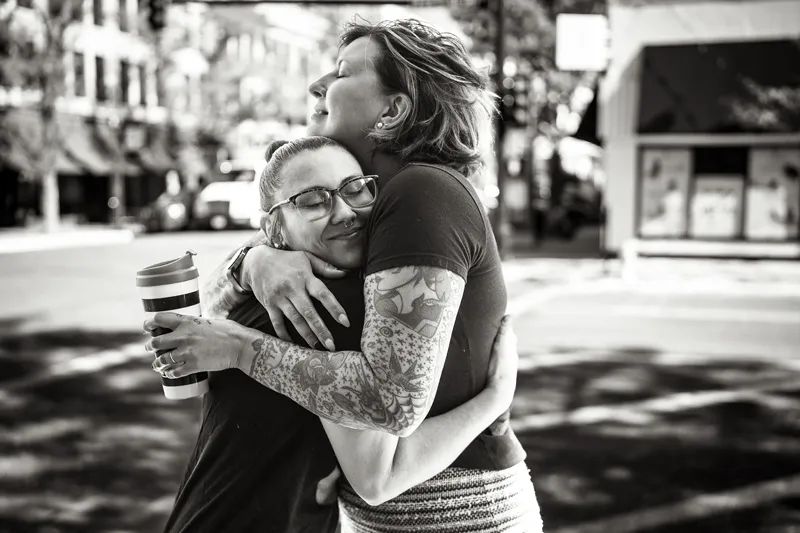
Tiffini Gallant relishes life post-transplant
Sister gifts kidney to save her sibling’s life
The first thing that struck me was their hearty laughter. From both of them — Tiffini Gallant and her sister Mikala Christensen.
I’d interviewed Tiffini a year ago for Yellowstone Valley Magazine, but this time I hardly recognized the young mother. This time she stood tall and spoke with a robust voice — so drastically different than the woman I’d met 11 months earlier. Back then, she was wracked by an excruciatingly painful kidney disease that left her barely able to rise from her chair.
In between interviews, Tiffini had received the new kidney she had so desperately sought. The priceless gift, which came from Mikala, gave Tiffini a new life.
Now, Tiffani can ride bikes and jump on the trampoline with her 6-year-old son, Holden. She can eat items, like salt, coffee and even beef jerky, that before had been definite no-nos. Today she lives with a host of other restrictions — many related to the immunosuppressant drugs she’ll have to take for the rest of her life — but they seem inconsequential compared to her previous state.
And the icing on the cake? She was hired back to her dream job at A&E + SMA Design, the very firm where she was working when a massive cyst in her kidney burst, sending her to the hospital and leaving her life ever-changed.
“They always told me they wanted me back,” she says. “That makes me feel valued and very fortunate. It’s still a little surreal, to be honest.”
As the sisters describe the transplant process through their different perspectives, their stories are frequently punctuated by their full-throated laughter. But that laughter occasionally breaks into choking sobs. Emotions still simmer close to the surface. Tiffini remembers all too well the excruciating pain, the prayers for a miracle, the fear that she’d not survive to raise her son. Mikala can’t shake the memory of watching her vivacious older sister suffer.
“It was very hard seeing this person who was so bright and beautiful and adventurous being ripped away,” Mikala says. “Seeing her come back — it’s so rewarding for me, that I could help bring her back. It’s been like two completely different people, like a light switch.”
Tiffini is six years older than Mikala, half-sisters born of different fathers. It was Tiffini’s father who carried the dominant gene for PKD, a disease that typically flares up as a person ages and is rarely so severe as the form that attacked Tiffini. Diagnosed at the age of 12, Tiffini’s PKD was manageable for years, although it sporadically sent her to the hospital. Her condition took a quick downturn, however, after she gave birth to Holden. Her doctors expected her health to rebound as time passed. Instead, it continued to worsen.
By last year, Tiffini was living with one kidney. The other, diseased and enlarged to roughly five times the size of a normal kidney, had already been removed. She was making monthly trips to Salt Lake City for lidocaine infusions to ease the pain. And then, last summer, she got the call that finally offered her a glimmer of hope. When tests indicated her second kidney was functioning below 20 percent, she celebrated. That was the threshold needed to put her on the list for a kidney transplant.
“It’s really hard to get people to understand why I wanted my kidney to fail,” she says. “But I knew I had to get sicker before I could get better.”
And that’s where Mikala comes in. In fact, Mikala had been awaiting the call ever since she was 6 years old, when her sister was first diagnosed.
“We’ve talked about it since childhood,” Mikala says.
Tiffini was told it might take years to find a donor and another year-plus for that donor to proceed through the pre-operative testing.
As the months passed, dozens of people responded to Tiffini’s highly public plea for a kidney. Some of them were Facebook contacts, others were perfect strangers. But one by one, they were eliminated from consideration.
“I only thought you’d need to have your blood and tissues tested,” Tiffini says. “But there are so many factors that would make someone ineligible.”
Meanwhile, Mikala passed through the basic screenings in a matter of months. But still, both sisters had been cautioned against being too hopeful.
“They say no one is your donor until you’re actually on the operating table,” Tiffini says.
Throughout the process, Tiffini allowed Mikala the grace to back out.
Of the 27,500 transplants performed annually in the United States, only about a tenth come from a living donor. In Tiffini’s case, a “live” donation would give her the best chance long-term.
Even as Tiffini’s remaining kidney continued to decline, she actively promoted kidney donation — for herself and for others — and provided what care she could for her son. Her biggest hurdle? Raising the $10,000 they required for her to undergo the transplant.
“I had to have that in the bank because I needed to prove on a dime that I could relocate to Salt Lake City for eight to 10 weeks and maintain my rent and bills here,” she says.
As a donor, Mikala had requirements, too. Not only was she advised to alter her diet and undergo physical tests, but her mental health was evaluated as well. The transplant surgery itself kept her in the hospital for only two days; she stayed on a couple more just in case of infection.
“It was easier than I thought it’d be,” Mikala says, pointing to the four-inch incision above her navel.
Tiffini underwent two operations, separated by only a few days. The first took place on June 11, to remove the remaining diseased kidney, which Tiffini describes as a “cystic football.” It was almost unbearable. The June 16 transplant surgery proved to be much easier, she says.
Post-surgery, she lived in Salt Lake City for eight weeks — two weeks shy of the typical transplant recipient — as her doctors adjusted her meds and she recovered her strength. By August, she’d returned to her Laurel home. By late September, she was set to resume her career as a writer at A&E.
While her life returned in a rush, it comes with strict rules. She’s got a binder that dictates what she can eat, what she can and cannot touch, when she’s required to quarantine and under what conditions she must wear an N-95 mask. For the first year post-transplant, she’s only allowed to have four people total into her home (we conducted this interview outside) and at the office, she wears a mask and her desk is located far from the flow of traffic. Never again can she eat sushi or enjoy a restaurant buffet. And if she craves a salad? All fresh produce must be washed in vinegar, she says.
Despite the many restrictions, Tiffini can hardly believe what her future now holds. “Coming out of survival mode, I’m just really excited to be in living mode,” she says. “I’m just feeling some semblance of normalcy, really. I’m getting better and stronger every day in every way.”
Meanwhile, her role as mother has become doubly important. Several years ago, Holden, too, was diagnosed with PKD. She frequently turns to the advice she was given back then.
“I was told ‘who better to show him how to live a life with PKD than you?’” Tiffini says.
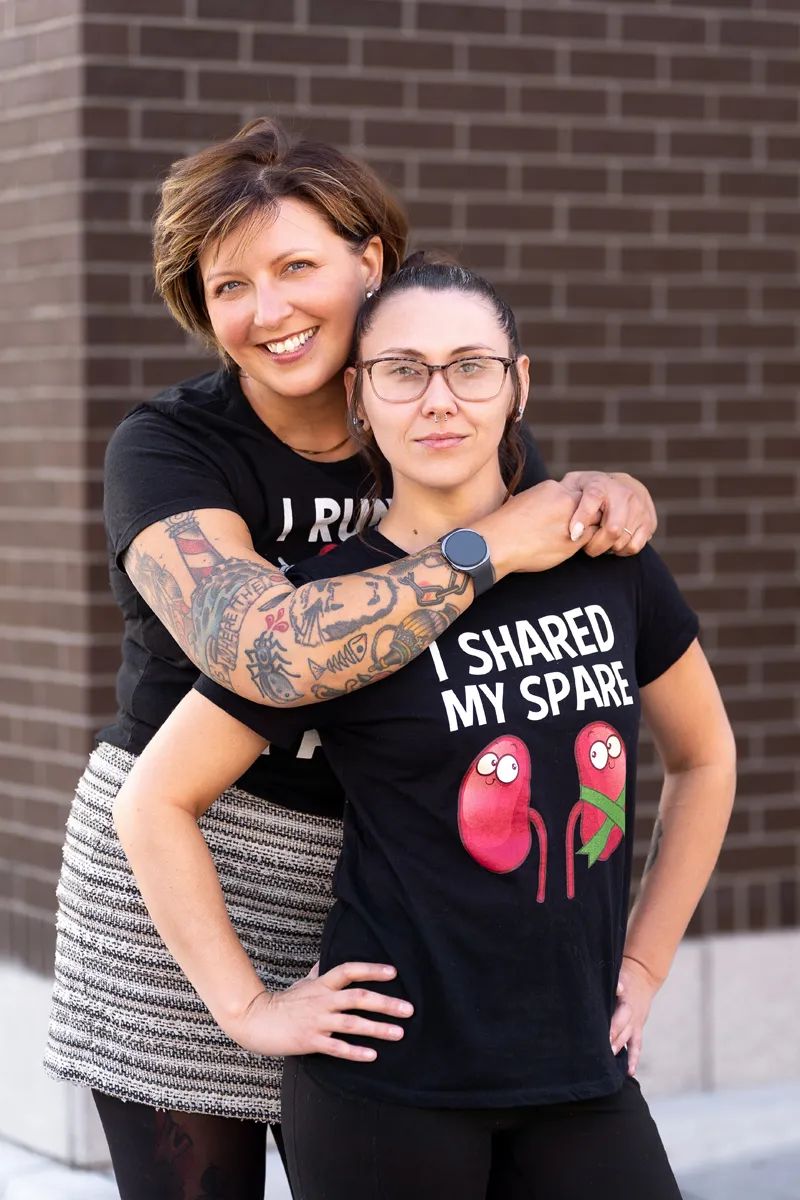
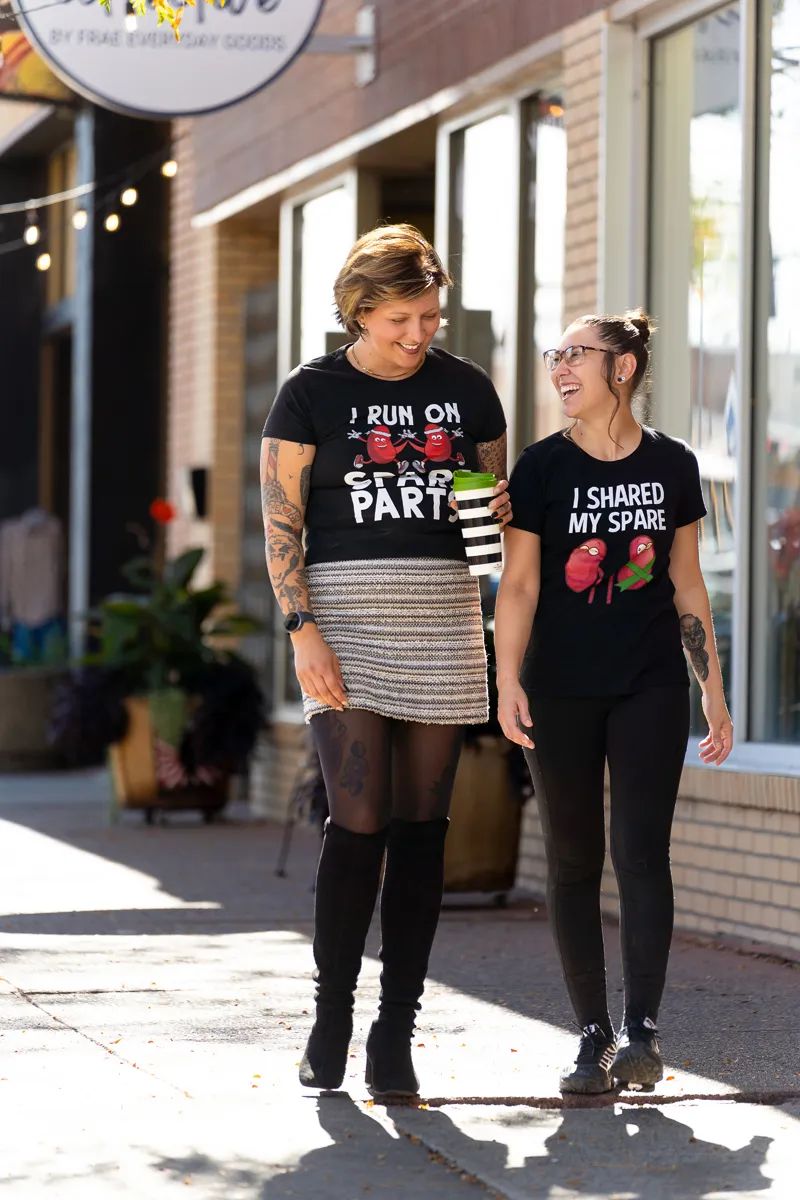
As the sisters share laughs, they mention the T-shirts they had made to celebrate their sharded kidney. Mikala’s reads “I shared my spare.” Tiffini’s reads “I run on spare parts.”
And then the tone turns more solemn as Tiffini reflects back to the day she learned that her second kidney had failed.
“I called Mikala, sobbing, and asked her if she still wanted to save my life,” Tiffini says. “Now here we are a year and a half later, and she did.”
“And I’d do it all over again,” Mikala adds, telling how a rush of happiness hits her when she least expects it. “It fills me with joy.”