

Unstoppable Hope
One mom’s fight for her little boy with big challenges
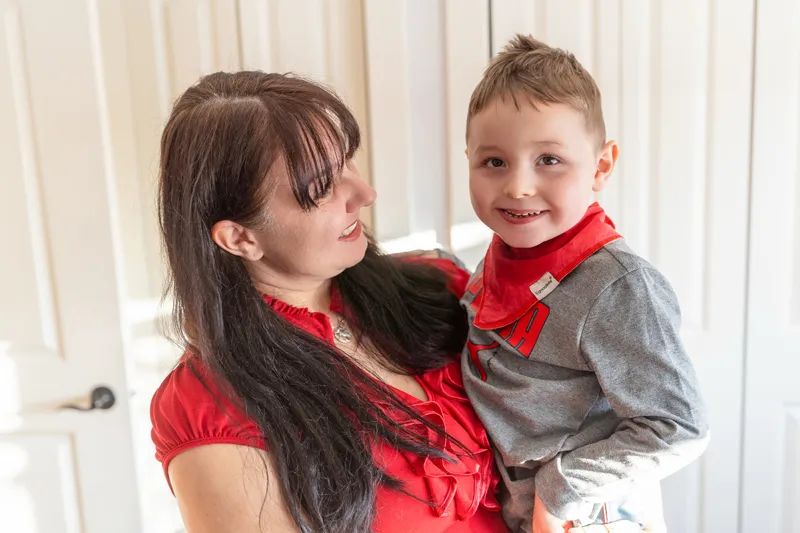
To meet James Thomas is to be filled with light.
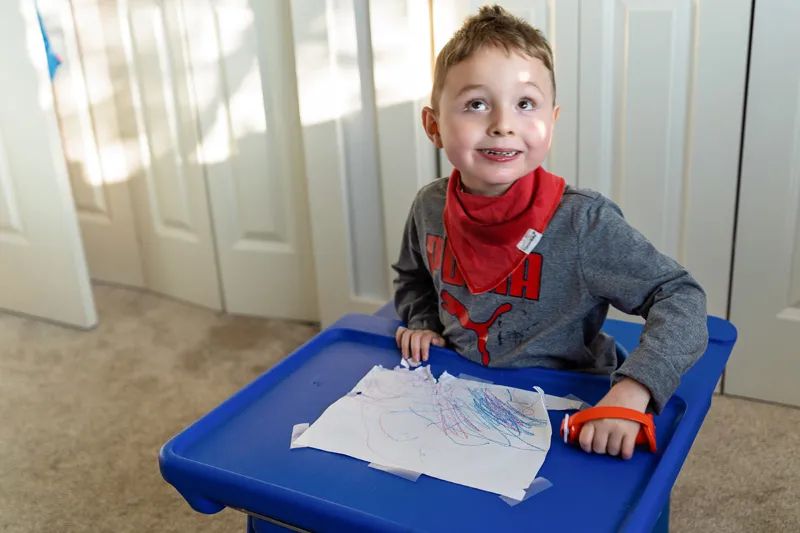
James, born with a rare genetic mutation, is a little, 5-year-old wonder. He exudes a contagious joy, despite his complicated disabilities, which cause him to be wheelchair-bound and developmentally delayed.
“He’s just made of love,” his mother, Katy, says. “I can’t know how many people he has touched.”
Katy is a tireless advocate for James, and with the support of family and friends, James is thriving.
James may be nonverbal, but there’s little doubt how he feels. He has strong eye contact and communicates with a steady gaze and expressive facial features. He laughs, fusses when he’s tired or not feeling well, and expresses joy by kicking and swinging his arms. He enthusiastically engages with everyone, visitors and strangers included.
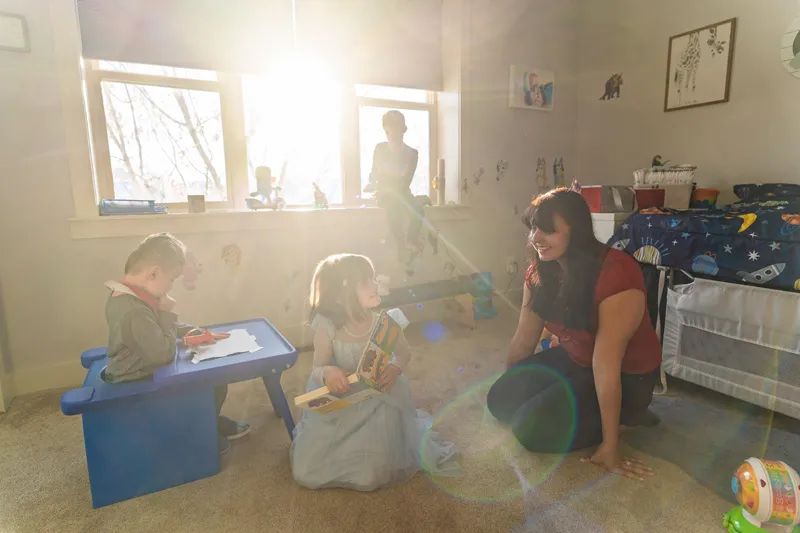
When James’s siblings George, 8, and Sofia, 5, his twin, read to James, it often seems as if he is hanging on every word. Sofia, an early reader, embellishes stories from books she knows by heart, and George reads from “Captain Underpants” and “Dog Man,” his favorite books.
Aside from family time, James’s favorite activity is working with a specialized robot, called a TREXO, that helps him walk.
He’s well known in his Billings Heights neighborhood, where he can often be found on the sidewalks in his TREXO. As soon as James is placed inside the device, he squeals with enthusiasm and punches the air, straining at the belts that hold his legs in place.
“He loves his TREXO,” Katy says, holding his hand as he takes slow, mechanical steps.
When James and Sofia were born, Sofia was given a clean bill of health, but James had club feet. Soon after birth, he was fitted with casts to correct them. The casts were challenging, Katy says, but nothing like what lay ahead of them.
Around James’s third month, Katy noticed some changes. James’s movements seemed to her to be out of the ordinary. When she took her concerns to his doctor, she was told to just get some rest. James’s unusual movements were nothing to worry about.
“My mama instinct knew better,” Katy says. “I was feeling so gaslighted and like I was crazy.”
Then, on a Sunday night, things took a turn for the worse. The jerky movements worsened and by Monday morning, Katy and James were at the emergency room, where he had a full-blown seizure. Within hours, they were on an emergency medical flight to Denver Children’s Hospital where James was diagnosed with infantile spasms. John caught up to them on a commercial flight.
Later that day, the doctors told Katy and John that James would never lead a normal life. The news was devastating. Katy remembers John, her always settled, always calm “rock” breaking down in tears at the news. She was shaken to the core.
“I didn’t know what to do,” Katy says. “I couldn’t catch my breath.”
What followed was a gradual acceptance as they fell into a routine that included multiple visits to Denver Children’s Hospital for medical care and various treatments to bring James’s seizures under control. James was diagnosed with a rare genetic mutation, STXBP-1, which was the cause of the seizures, and other disabilities.
Katy and John quickly became a well-oiled machine, organized and ready to adjust to any crisis at a moment’s notice. With George only 3, and Sofia still an infant, they relied heavily on John’s parents, who live nearby, for childcare.
“Everybody just picks up a chunk, and we all work together,” Katy says. “It’s just a lifestyle now.”
That lifestyle, for Katy, includes a lot. Katy is from Romania, and while she was in Romania, she earned her bachelor’s degree in social work. Seeking adventure, she came to the United States on a diversity visa — a rarity in 2012. After moving to the U.S., she earned her master’s in social work from the University of Wyoming.
As a social worker, Katy has worked with children for 13 years and has worked for Billings Public Schools for nine years. She currently works with at-risk youth at Castle Rock Middle School. It’s emotionally challenging, but she enjoys being a safety net for the kids in her program.
“They’re all trying to find their way in the world,” Katy says. “I wouldn’t have it any other way.”
Katy also maintains a private therapy practice in the evenings through Talk Space, an online platform, something she’s also deeply committed to.
“I’ve been through a lot with my clients,” Katy says.
Katy’s stress load is huge, but she manages to keep it together — calendar in hand with every detail planned — until the next time James is hospitalized, then Plan B clicks into place, and she has that planned too.
In addition to his visible disabilities, James has a weakened immune system and deals with lots of respiratory issues. Trips to Denver Chidren’s Hospital are still frequent and most trips are unplanned and happen in a moment’s notice.
At home, John cares for George and Sofia.
With James as a brother, George has become more independent and self-reliant than most 8-year-olds, and he’s always willing to help. He rides his bike to school on his own and looks after Sofia.
Although she’s 5, Sofia is still in preschool. She loves to dress up in outfits as sparkling as her personality.
“She never shows up to disappoint in any situation,” Katy says.
For most of Sofia’s early years, James was in and out of the hospital. She too has had to mature sooner than most children and has loads of patience for a child her age.
“They’ve been a part of it all and they love their little brother like no other,” Katy says.

In addition to John’s parents, the Thomases have a strong network of friends they lean on for support.
“It was very catastrophic in my thinking at first,” Katie says. “I thought we were going to be so alone in this journey because no one was going to know that to say or do, and it’s been exactly the opposite. It let them in instead of drove them away.”
It was that network of friends and family that helped make the TREXO a reality for James.
TREXO is a Canadian medical device that’s not available in the U.S. It cost roughly $35K. None of it would be covered by insurance, but Katy had a feeling that it would be beneficial for James, so she decided to ask her community for help and launched a fundraising campaign.
The results were astounding.
The Thomases received loads of support from friends and neighbors, and the community fell in behind their efforts as well, with bingo fundraisers, fundraisers at restaurants, bake sales — anything and everything.
Katy wouldn’t take no for an answer, and when one opportunity fizzled, she moved onto the next. John, who is usually reserved and prefers a behind-the-scenes role, became a visible and active advocate for James, volunteering for TV and radio shows.
“When it comes to James, he’s all-in for anything he needs,” Katy says.
Katy and John set a three-year goal to raise $1,000 a month and instead they raised $35,000 in three months, including a $10,000 sponsorship from the Montana Hope Project.
With a $35,000 check in hand, Katy and John ordered the TREXO, only to find that the device could not be shipped to a U.S. address. The news was devastating, but they didn’t give up. They found a friend of a friend of a friend who had a Canadian address, and had the TREXO shipped there, then drove to Canada to pick it up.
It’s only been a year, and the TREXO has been life-changing for James. So far, he has walked 319,857 steps with the help of the robotic device.
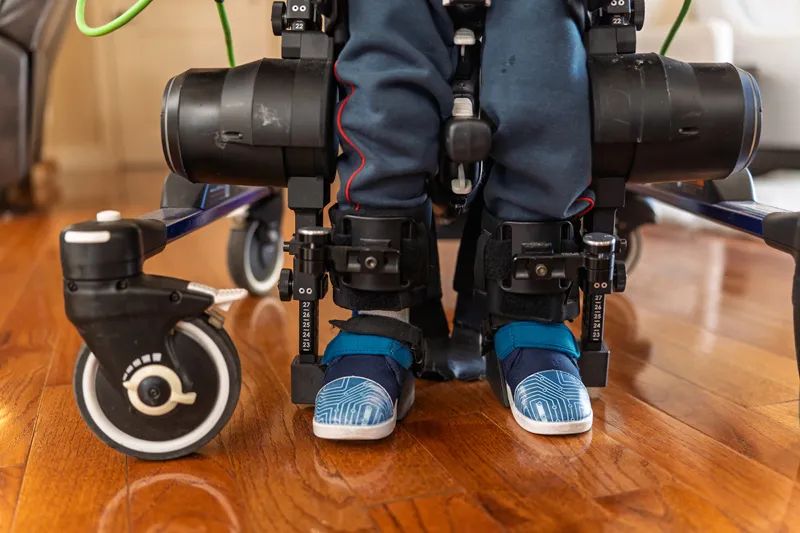
He walks for 40 minutes a day, weather-permitting. When it’s cold or rainy, Katy and James head over to the middle school where she works and they walk the halls. The movement has helped James build and maintain muscle mass and control. The robot is controlled by a sophisticated app and measures James’s effort compared to the effort of the robot (delete: and) In the past year his share of the effort has increased from around 20% to more than 60%.
The TREXO will grow with James into adulthood, with periodic modifications every time he grows out of it. It will be a few years before he’ll need his first upgrade.
Even with the TREXO, progress is slow for James. He still spends a lot of time in various therapies, including physical therapy, speech therapy, occupational therapy, and he enjoys swim therapy and horseback therapy in the summer months. Every year, Katy goes to Colorado Springs with James for a 6-week intensive therapy session to aid his progress.
For now, there is no treatment specifically for STXBP-1. The medicine that he’s on to control his seizures causes eventual blindness.
“You make many tough medical decisions because you literally have no other options,” Katy says.
Last year, she and John were faced with a decision to enroll James in a clinical trial for a new treatment for his genetic disorder. The trial came with serious risks, but great potential. In the end, Katy and John decided against the treatment. Fast forward one month, and they heard one of the children in the trial had died. It shook Katy.
“This was such a point of hope for everyone in the (STXBP-1) community, and this felt like a dead end,” she says. “So much of it is holding hope while having acceptance so you can survive this journey.”
No matter what comes next for James, Katy is empowered by her experience. She knows that with her network of friends and family she can do anything.
“If it’s about James,” Katy says, “I’m unstoppable.”